Showing posts with label Jean-Pierre Melville. Show all posts

喋血双雄 - The Killer (1989)

"I always leave one bullet, either for myself or for my enemy." Joe

"I always leave one bullet, either for myself or for my enemy." Joe

☆ Masterpiece 


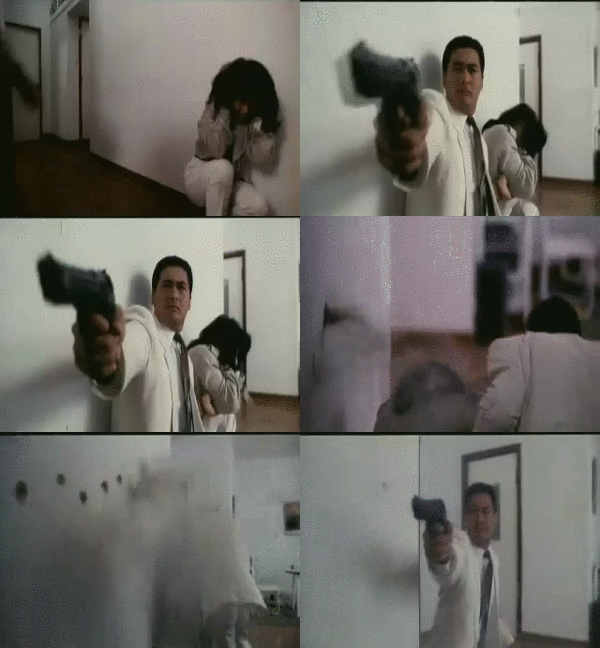
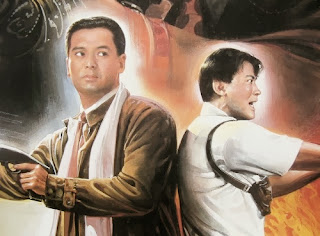
喋血双雄 - The Killer (1989) is a ballet of bullets.


Directed By John Woo.


Starring Yun-Fat Chow, Danny Lee and Sally Yeh among others.

I first saw The Killer in an art house theater late one night by myself. I came out blown away by the ballet of bullets throughout the film. John has said his film is about honor and friendship. Woo said he was influenced by Jean-Pierre Melville's, Le Samourai (1967) and Martin Scorsese's, Mean Streets (1973). I can clearly see the the influences of both directors and their respective films in The Killer. John like Melville has an honorable, cool, calm and cunning assassin and yet the film has the violence and grit of Scorsese's, Mean Streets. The combination is both riveting and revolting. The Killer in turn has influenced directors, Robert Rodriguez' El Mariachi (1992), Quentin Tarantino's  Jackie Brown (1997) and Luc Besson's  Nikita, La Femme Nikita (1990).

In the scene below watch the shootout and the incredible chemistry between Chow and Danny. They make the complicated action sequences look as easy to do as walking across a minefield with magnets attached to your feet.


Trivia - Woo filmed the picture in 92 days, at a cost of 2 million US dollars. The beach house shootout was filmed in 28 days with 20,000 rounds of ammunition fired. The final church shootout took 36 days and 40,000 rounds.


  • ALT
  • ALT
  • ALT
  • ALT
  • ALT
  • ALT
  • ALT
  • ALT
  • ALT
  • ALT
  • ALT
  • ALT
  • ALT
  • ALT
  • ALT
  • ALT
  • ALT
  • ALT
  • ALT
  • ALT


Note - If you would like to view 喋血双雄 - The Killer (1989) to rent or buy please click on the link below the comments. It is sponsored by Google, so it is the safest and most secure way to get a copy for your film library.

Croupier

"Hang on tightly, let go lightly." Jack

"Hang on tightly, let go lightly." Jack

☆ Classic 


Croupier (1998) is an intelligent, taunt neo noir thriller.

Directed by Mike Hodges.

Starring Clive Owens, Alex Kingston and Gina McKee among many others.


Hodges creates a thriller that is elegant and intelligent without the usual violence associated with gambling films. Mike has Clive narrate the story as a third person as though he is writing a novel. The narration brings out the subtext within the scenes. Owens slick haired, detached characterization and supreme confidence reminds me of Alain Delon's character portrayal in Jean-Pierre Melville's, Le Samourai (1967). The ending Mike crafts really is surprising and effective.

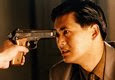
Clive's performance brings together Hodges elegant direction and Paul Mayersberg taunt script. I have always thought that Owens would make an intelligent James Bond. In the scene below watch Clive's eyes reveal how truly he is captivated with Gina's beauty. Clive's honesty is his trade mark. I get the feeling that a gun to Clive's head could not get him to be dishonest in a moment. One of the most sincere actors working today.


Trivia - Disqualified for the Oscars due to it being first shown on Dutch Television.


Bob Le Flambeur - Bob The High Roller

"Possibly, I will sue the police for damages." Bob

"Possibly, I will sue the police for damages." Bob


☆☆☆☆☆ Masterpiece

Bob Le Flambeur (1956) is a deceptively simple crime drama that revolutionized film making.

Directed by Jean-Pierre Melville.

Starring Roger Duchesne, Isabelle Corey, Daniel Cauchy among many others.

Melville's Bob Le Flambeur inspired and started the entire French New Wave of film makers. Study this film and you will see all the film elements that are now standard in modern films.

When I first viewed Bob, I was not all that impressed with Bob to be honest. It was just so simple and straight forward to my modern eyes. That is until I looked at the date it was made (1955). When watching a film you have to pay attention to when it was made, so you can compare it to other films made during that era and afterwards. When I'm watching an older film like Bob, I'm looking at it with a set of unspoken guidelines that modern films of my era have instilled in me. Thus, when I see a picture like Bob which was made before I was born, I see the beginning of the unspoken guidelines that modern film makers have instilled in me as audience member. Some of Bob's landmark film making techniques used today are: Bob was filmed using a hand held camera (Steven Soderbergh), uses gritty out door scenes(Martin Scorsese), violence away from camera(Alfred Hitchcock), existential ending (Paul Thomas Anderson), etc... With Melville's, Bob, you see all of these modern guidelines that film makers now use on their audiences.

The whole point of Bob is that a man (a criminal in this case) has to have a set of values, morals and ethics that he has to follow zealously to be respected by all men and women. It is such a simple character trait, but it makes Bob into a hero instead of the petty criminal. Bob's criminal and gambling traits drive and motivate every minute of his existence. The slot machine in his closet is played by him even after a losing night of gambling.

In the scene below, Bob played to perfection by Roger Duchesne and the sexy, seductive flower girl is Isabelle Corey. Isabelle steals almost every scene she is in throughout the film with her sensuality. Look at how she gazes at Roger. Corey layers an unfulfilled longing  into a simple nude scene in bed. Considering how strict the film codes were at that time I was surprised that these provocative and suggestive nudes scenes were kept in the original cut of the movie.

Anyways, I'm trying to understand why a flower scene occurs twice in this film. Bunuel gave this type of director hint to his audience in Belle De Jour - Beauty Of The Day (1967). Melville is saying something secretly to his audience. I will need to watch several more of Melville's films to see if he uses flowers again. A great movie to watch with an ending that is really amazing which ensures it will play on forever.


Trivia - Melville auditioned and rejected Alain Delon for Paolo, fearing he would steal the film.



A Bout De Souffle - Breathless

"Are you afraid of getting old? I am." Patricia

"Are you afraid of getting old? I am." Patricia


☆☆☆☆☆ Masterpiece

A Bout De Souffle - Breathless (1960) There was before Breathless and there was after Breathless.

Directed by Jean-Luc Godard.

Starring Jean-Paul Belmondo and Jean Seberg.

With one brilliant editing idea to solve an overly long film, Godard ushered in the modern movie era with its revolutionary use of "Jump Cuts" (a cut in a moment within a scene, regardless of continuity to the scene or next moment within the edited scene).

Godard was not satisfied with the long version of the Breathless and his  asked mentor, Jean-Pierre Melville (who's film, Bob Le Flambeur (1956) had influenced his own film making aspirations)). Melville is considered the Godfather of The French New Wave, of which, (Breathless is one of the key films) for advice. Jean-Pierre suggested to Godard that he should cut scenes entirely, including his own (Melville plays the writer who is interviewed by Jean Seberg's character). Godard in a flash of inspired genius created the cut within scenes or "Jump Cuts". Melville is said to have declared the cuts, "Excellent" and the modern film was born. Breathless is to cinema what Marlon Brando is to modern acting.

Jean-Paul Belmondo is what makes Breathless, so... Breathless. Belmondo is playful, arrogant, but above all a likable killer. My only gripe with Godard's film, is that he doesn't properly explain, visually to the audience Belmondo's signature character trait(the swiping of his thumb across his lips). My first, second and third viewings of Breathless left me erroneously blaming Belmondo. I have a Method Acting background that requires me as an actor to fully express any and all character actions in a way that audience members can easily comprehend and or relate. As audience member I knew the action was  somehow related to Humphrey Bogart and his movies. Belmondo's character was constantly quoting from and trying to emulate Bogie's fictional persona in his own life. It wasn't until I researched Humphrey Bogart and discovered that Bogie had a natural tick which caused him to swipe his lips with his thumb. With this new insight I watched Belmondo's work again and discovered that it was Godard at fault for me as an audience member not being able to understand Belmondo's swipe. What Godard had needed was a scene from a film where Bogie swiped his lips and Belmondo imitated this action silently in a movie theater. Godard does have Belmondo swipe his lips with his thumb, as he looks at Humphrey's movie poster outside a movie theater, but I as a modern audience member, who has never observed Bogart do his natural tick in a movie could not put the two together on my own. What is strange is that when Jean's character rubs her thumb across her lips at the end of the film as an audience member, I immediately understood that Jean's character had taken on Belmondo's persona.

In the scene below, there are no "Jump Cuts", but there are "Jump Cuts" within the overall larger apartment scene that this scene is a part of. The scene below really captures the incredible chemistry between Belmondo and Seberg. They are both mesmerizing to watch.

One last point about Breathless, is that it truly is a film made by a collaborative team. It's the collaboration between director, actors, cinematographer and editors. It was made as they went along. Godard would write new scenes and give them in the morning to the actors and everyone involved would contribute as they shot it. This is a great film, that looks as good today as anything Quentin Tarantino makes. Enjoy!


Trivia - Godard fed the actors their lines as he was filming. To give their performances more spontaneity.