Showing posts with label Michelangelo Antonioni. Show all posts

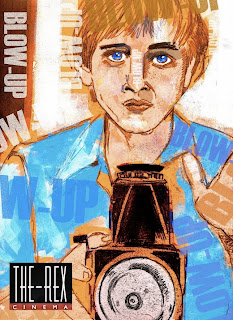
Blow-Up


"What did you see in that park?" Ron

☆☆☆☆☆ Masterpiece 


Blow-Up (1966) is a stylish and visually ravishing look at the enigma of reality versus illusion.


Directed By Michelangelo Antonioni.


Starring David Hemmings, Vanessa Redgrave, Sarah Miles, Veruschka and Jane Birkin.


Michelangelo revisits his recurring theme of reality/illusion that he started with L'Avventura (1960).
Antonioni spent his entire career asking, where does reality or illusion begin or end. The plot for Blow-Up was inspired by a short story called, "Las babas del diablo" or  "The Devil's Drool" (1959) by Julio Cortázar. The translated short story was renamed Blow-Up or Blow-Up and Other Stories. The photographer that David played was inspired by the life of London fashion photographer David Bailey.  Herbie Hancock did the score for the film and called the music Diegetic, and said, "It's only there when someone turns on the radio or puts on a record."

What really struck me as I watched Blow-Up was the scene below where David's character is lost in the "Process" of his photographic art. As an actor I get, so lost in my artistic Process that I forget to eat, sleep, drink, sex, etc... There is no sound, dialogue or music in the clip below yet Michelangelo guides us through David photographic Process to gradually see what he begins to see in the series of photos he took. Its like being in a detectives investigative process as he gradually uncovers the story hidden within the photos.


Trivia - Michelangelo Antonioni had the grass in Maryon Park sprayed green so he could re-shoot the scene the way he wanted it to look.


  • ALT
  • ALT
  • ALT
  • ALT
  • ALT
  • ALT
  • ALT
  • ALT
  • ALT
  • ALT
  • ALT
  • ALT
  • ALT
  • ALT
  • ALT
  • ALT
  • ALT
  • ALT
  • ALT
  • ALT


Note - If you would like to view Blow-Up  to rent or buy please click on the link below the comments. It is sponsored by Google, so it is the safest and most secure way to get a copy for your film library.

The Matrix

"Free your mind." Morpheus

"Free your mind" Morpheus

☆☆☆☆☆ Masterpiece

The Matrix (1999) put the final nail on 35mm prints coffin and ushered in the digital film making age.

Directed by Andy and Lana Wachowski.

Starring Keanu Reeves, Laurence Fishburne, Carrie-Anne Moss and Hugo Weaving among many others.

I remember going to the theater early in the morning to see The Matrix when it first opened.
I was so amazed at the visuals that as soon as it finished I went back to the box office and saw it again. I did this one more time. The film still has that visual impact when I saw it again recently.

The Wachowski brothers freed my mind to the limitless possibilities that exist within our imagination. The opening scenes with Carrie-Anne and the bullet dodging scenes throughout the film forever changed the way movies are made. Andy and Lana also helped me to visually understand the mental freeing process that The Actors Studio MFA program had been helping me to attain. Whether we are in a Matrix or not, is not as important to me as having the freedom to explore the world we are in and who we really are. Most of the philosophical dialogue went over my head, but the visuals explained everything to me. The Matrix visually reminds me of Michelangelo Antonioni's, L 'Avventura (1960). Andy and Lana like Michelangelo prefer to tell a story visually. The story and dialogue only further the visuals impact.

Hugo's acting is superb throughout the film. Weaving's slow, methodical, menacing and humorous line delivery was a joy to watch. I compare Hugo's vocal delivery to Merly Streep. Both actors use their voice's to bring out the subtext that the dialogue alludes to. The scene below illustrates Hugo's masterful vocal delivery to bring out a deeper understanding of the character that the story lacks. Enjoy!


Trivia - Metacortex, the name of the company Neo works for means, "transcending the boundaries of the brain." Meta, transcending; Cortex, the grey outer part of the brain.


L 'Avventura - The Adventure

"Giulia is like Oscar Wilde. Give her all the luxuries and she will manage without the little necessities." Corrado

"Giulia is like Oscar Wilde. Give her all the luxuries and she will manage without the little necessities." Corrado


☆☆☆☆☆  Masterpiece

L 'Avventura - The Adventure (1960) is an Italian cinematic masterpiece that takes audiences on a visual adventure.

Directed by Michelangelo Antonioni.

Starring Monica Vitti and Gabriele Ferzetti among many others.

The film was released at the same time as Federico Fellini's La Dolce Vita. Fellini and Antonioni started the Italian New Wave. Both films were introduced at the 1960 Cannes Film Festival. Fellini's film won the Palme D'Or while L'Avventura took The Jury Prize.

The cinematography was by Aldo Scavarda and the editing by Eraldo Da Roma. I mention the cinematographer and the editor, because their work is so integral to the adventure Michelangelo takes his audience on.

L'Avventura is easy to understand if you allow the film's visuals and its long scenes (which lack the modern "Jump Cut" edits, created by Jean-Luc Godard for Breathless) to create your own story and narrative. The opening scene below is a perfect illustration of what Michelangelo, Aldo and Eraldo give the audience visually and editorially, so that the audience can make the adventure come alive for them individually. In the scene below the visuals not only help the audience to create their own story, but more importantly help Antonioni make scathing social commentaries on technology. Note the contrasting visuals between the old and the new in the scene. To the right we have an old sprawling villa with a magnificent Roman arch, whose surrounding Forrest's have been cut down to make way for modern tightly packed multi family housing. Also note the road that separates the old villa from the new apartment buildings heads towards a distant Renaissance Dome in the background. Antonioni is visually showing us the contrasts between the old ways and the new ways. There are many other contrasts between the old and new in the scene below, but I'll let Antonioni's visuals speak to you, so you can explore them for yourself and come up with your own story.

As an audience member I felt as liberated by this film as I do when I read a novel. Just as in a novel, Michelangelo keeps the dialogue simple and the visuals complex to allow me to explore his visuals at a readers pace, which like in a novel allows the audience member to create the story for themselves. Enjoy!


Trivia - At the 1959 premier at the Cannes Film Festival, Michelangelo and Monica fled the theater, because the of the violent reaction from the audience to their film. It went on to win a Special Jury Prize. La Dolce Vita by Federico Fellini won the Palme D'Or that year. 


Solaris (1972)

"Whenever we show pity, we empty our souls." Kevin

"Whenever we show pity, we empty our souls." Kevin


☆☆☆☆☆ Masterpiece

Solaris (1972) is a haunting Russian Sci-Fi cinematic poem on love, reality and the past.

Directed by Andrei Tarkovsky.

Starring Donatas Banionis and Natalya Bondarchuk.

Solaris' pace is purposefully slow, so as to allow the audience the time to reflect and fill in the missing components of the characters and their stories.

As an audience member, my first viewing was painful. This was due to the fact that the films slow pace gave my mind the time to reflect on my past. No matter how hard I tried to focus on the present film scenes, the long sustained visuals kept taking me back to places I had long put away. As an actor I was left speechless, because at first I did not understand what the director Andrei was doing to me. After about the first thirty minutes I let go and was taken on a fascinating journey of my and the characters inner life.

Solaris makes you question what love is. Are we in love with a person or the idea of that person. Let the film help you answer that for yourself through the relationship that develops between Donatas and Natalya. The next theme for Solaris to explore was to help us question what constitutes reality. Again, let the film by way of an astounding, performance by Natalya help you to travel that world within yourself and the relationships you share with your loved ones. Natalya is simply mesmerizing. As an actor I would be in heaven doing scenes with an actress sharing so freely her inner life. Natalya kept drawing me in with her deep understanding of the complexity of the subject matter she was asked to explore with her audience and fellow scene partners. The final theme Solaris explores is your past. The actor Donatas beautifully helps us as audience members deal with our past by unlocking his. As the film slowly progresses the theme of our pasts takes the entire film to traverse. The conclusion with our past is that we have to study it carefully and then accept it before we can move on.

The visual ending upturns the whole movie's themes in a way that is beyond description. Visually, Solaris' ending is an mystifying as the ending in Michelangelo Antonioni's L 'Eclisse - The Eclipse (1962).
Get ready for the journey you have been avoiding your whole life. If you are a film maker with an empty wallet for your Sci-Fi film study Solaris. Andrei did Solaris on a micro Soviet era Ruble budget. In the scene below let the visuals engage your subconscious. See what starts brewing in your mind. Let the images help you to open up within yourself.


Trivia - The scene where Breton is riding back in the car was filmed in Osaka and Toyko, Japan. Andrei's  wrote in his journal, that they had just missed the World's Fair. Andrei filmed in Japan, because he wanted to make the audiences in Russia feel like they were in the future.


L 'Eclisse - The Eclipse

"As long as we were in love, we understood each other. There was nothing to understand." Vittoria

"As long as we were in love, we understood each other. There was nothing to understand." Vittoria


☆☆☆☆☆ Masterpiece

L' Eclisse - The Eclipse (1962) is a Italian cinematic masterpiece of character study and visual artistry.

Directed by Michelangelo Antonioni.

Starring Monica Vitti and Alain Delon among others.

It's hard to explain a film directed by Michelangelo, because they are made to allow the viewer to formulate their own narrative. I suggest turning off the sound and letting your mind formulate a story. Therein lies the true genius of Michelangelo's directing style and story telling. There is no story or narrative to follow throughout the film only to view the characters lives and let your imagination fill in the story. The audience members become the directors of the movie.

The scene in the clip below is a perfect example of how Michelangelo tells the characters story through their interactions and movement and the backgrounds they inhabit. There is no sound in the scene below, but watch everything in the scene to its most minute detail. Carefully watch how the actors speak with their actions, looks and body language. As an audience member watching the scene below you begin to fill the story yourself by what you see visually.

As an actor I would have found Michelangelo's directing style stifling at first, because he probably directed his actors, so precisely as to tell them were to place a hand, foot, etc...  I have worked with directors like this on stage. Once you understand what is being conveyed in a given moment, they will allow you to internalize and color each moment in your own unique way, while still adhering to the directors minute moment to moment directions. An actors job is not easy.

In the scene below as an audience member my minds starts filling in the unspoken dialogue, their background stories and where this scene is going as I begin to listen to the characters with my eyes. My favorite moment is when the camera glances (from the perspective of Francisco Rabal) at Monica's curvy and sexy legs from the mirror like reflection in the marble floor. As an audience member I understand at that moment that their relationship had tons of passion. Notice, how Monica's left leg lifts ever so slightly and suggestively as we look at her legs. This is a woman that knows how to get a man's engine firing on all cylinders.

Without giving anything away, the ending is visually beyond description. It is probably one of the greatest ending ever put to film. The ending is as visually haunting as Andrei Tarkovsky's Solaris (1972).


Trivia - L 'Eclisse won The Special Jury Prize and was nominated for The Palme D'Or at the 1962 Cannes Film Festival.